Bangladesh Agricultural Research Council (BARC), Dhaka | May 17, 2026
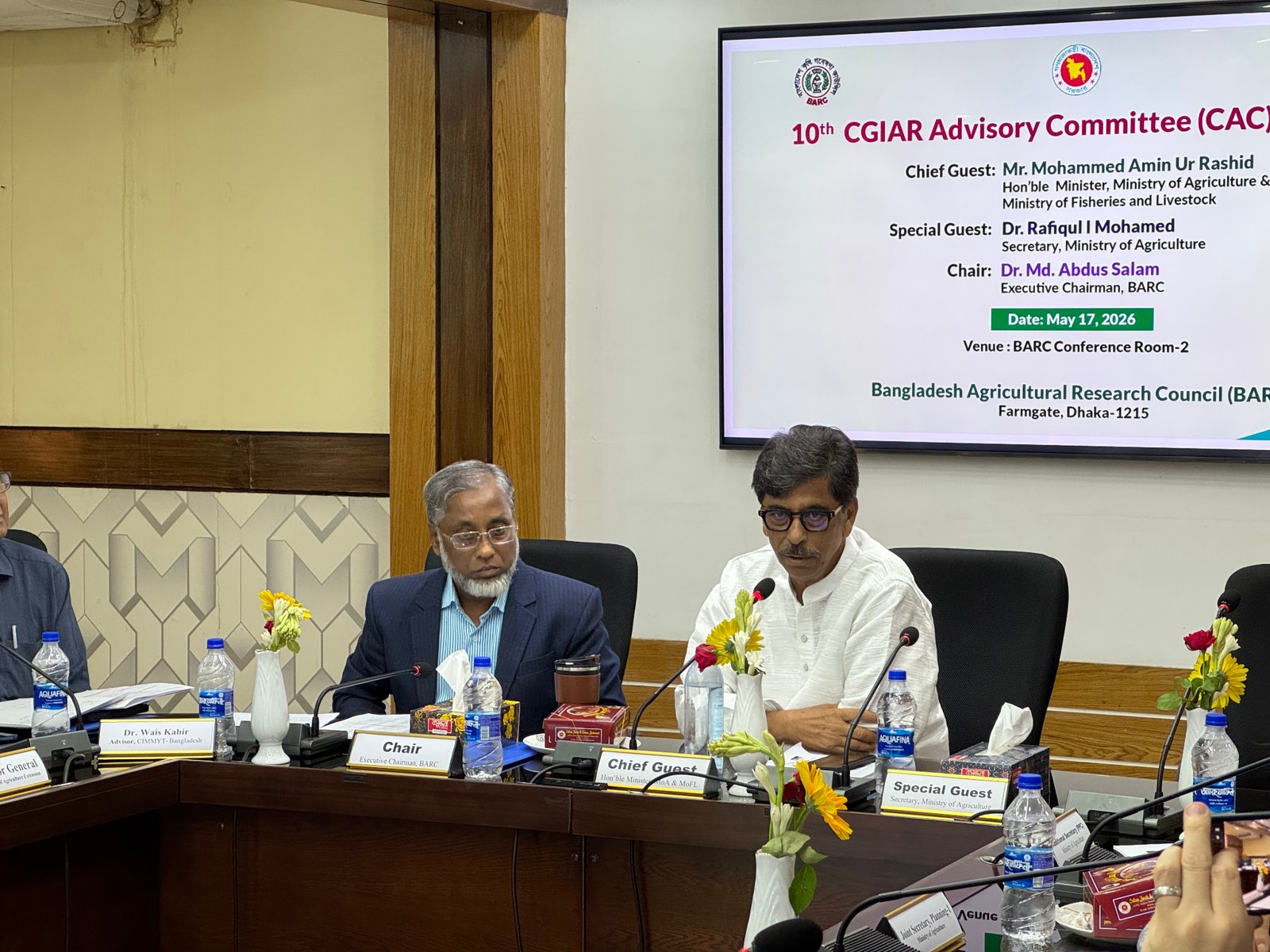
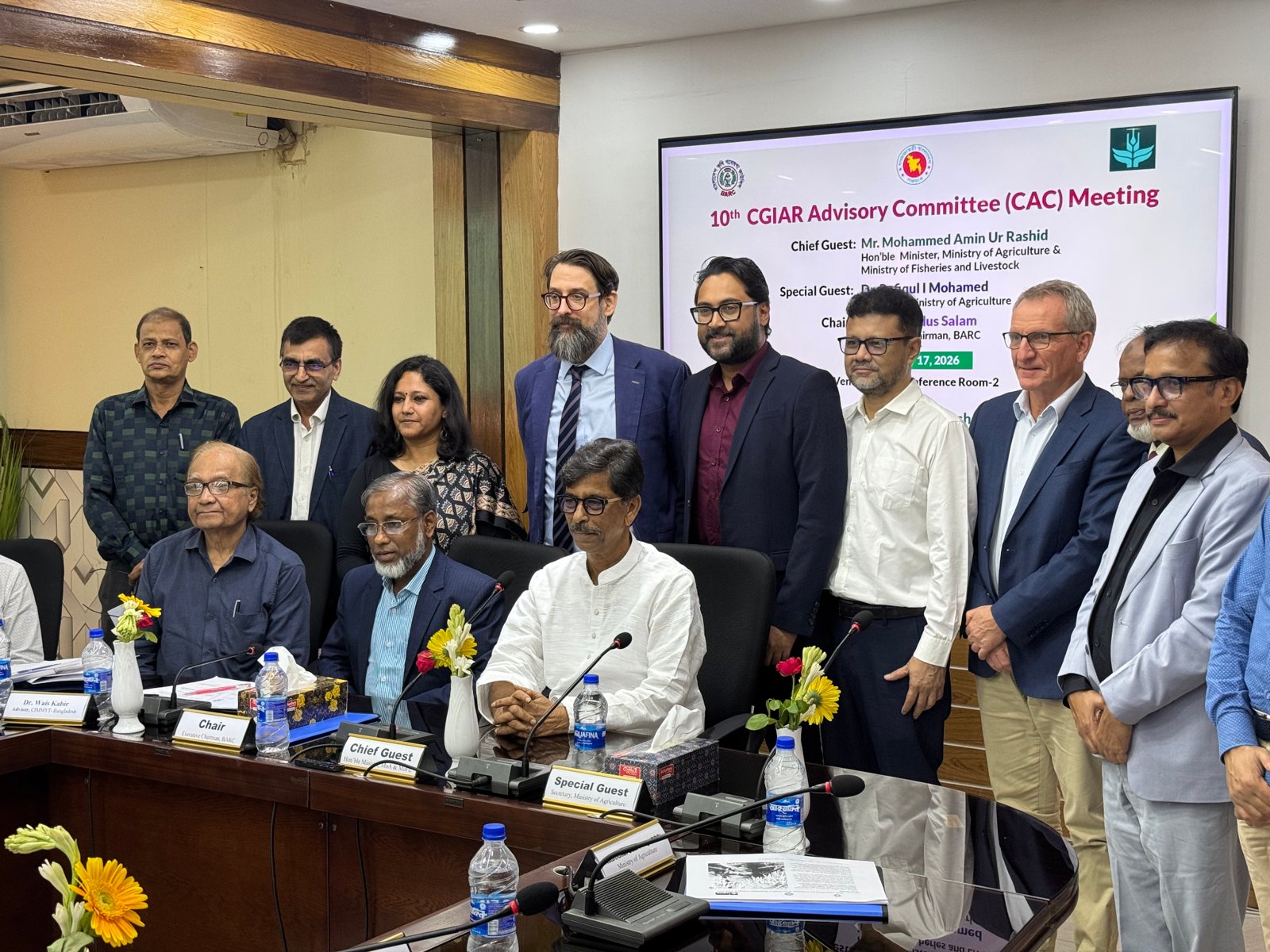
On May 17, the Bangladesh Agricultural Research Council (BARC) hosted the 10th meeting of the CGIAR Advisory Committee (CAC) — a biannual forum where international agricultural research centers align their work with national priorities. Hosted by the CGIAR Science Program on Scaling for Impact (S4I), the event welcomed the Honorable Minister for Agriculture, Mr. Mohammad Amin Ur Rashid, as Chief Guest, alongside the Secretary of Agriculture, Dr. Rafiqul I Mohamed. Representatives from all six CGIAR centers in Bangladesh—IFPRI, IRRI, CIMMYT, CIP, IWMI, and WorldFish—presented at the event.
The Ministry's Priorities
The Honorable Minister was direct in outlining the Ministry of Agriculture’s main concerns: safe food is the government's foremost priority — not just quantity, but quality. Concerns about heavy metals in rice and food safety for export markets were front and center. Bangladesh has the potential to be a serious agricultural exporter, he said, but realizing it requires producing food the world trusts. He called for reduced fertilizer dependence, a shift from diesel irrigation to solar, and closed with a generational charge: leaving a healthy, productive world for our children is a duty, not an option.
Research Across Other CGIAR Centers
The six centers presented decades of collaborative impact. CIMMYT highlighted 40+ years of wheat and maize partnership and mechanization support through 700 light engineering workshops. IRRI reported that 81% of Bangladesh's improved rice varieties carry IRRI germplasm, and announced the 2026 release of BRRI Dhan 180 — a jointly developed, world-record-yielding variety. CIP focused on short-duration potato varieties and biofortified cultivars for southern Bangladesh. IWMI presented work on solar irrigation, salinity management, and flood forecasting linked to farmer advisories. WorldFish highlighting partnerships that have contributed to a fourfold growth in Bangladesh's aquaculture output and ongoing work on fish systems for nutrition and livelihoods.
IFPRI's Role: Evidence into Policy
IFPRI has worked in Bangladesh since 1988, and the CAC meeting underscored how that partnership has shaped national food and agricultural policy. The Bangladesh Integrated Household Survey (BIHS) — entering a new round in 2026 through Cornell University — combines agricultural, nutrition, and gender data in a single nationally representative rural panel. The Transfer Modality Research Initiative (TMRI) showed that combining cash or food transfers with nutrition behavior change communication improved food security, reduced poverty, and improved child nutrition — directly shaping the Mother and Child Benefit Program. ANGeL, implemented with the Ministry of Agriculture, demonstrated that integrated training in agriculture, nutrition, and gender improved farmer incomes and women's empowerment enough to prompt national scale-up. Active work on digital payments, fertilizer subsidy reform, and school feeding continues to align with the government's agenda, as do IFPRI-designed institutions — the Food Planning and Monitoring Unit (FPMU) and the Agricultural Policy Support Unit (APSU) — which continue generating policy evidence for both the Ministries of Food and Agriculture.
A Partnership Worth Sustaining
A candid thread ran through many presentations: donor retreats are straining research budgets across all centers. The CGIAR leadership asked directly for government guidance on sustaining the partnership — exactly the dialogue the CAC exists to enable. The 10th meeting reaffirmed that the most durable research investments stay close to policy and to people.
IFPRI has maintained a continuous research presence in Bangladesh since 1988. The CGIAR Advisory Committee meets biannually, co-organized by BARC and the six CGIAR centers active in Bangladesh.